When talking to other groomers, I often notice that few of them mention the use of stand drying in everyday styling. What was once one of the few drying options available is now falling out of favor. There are plenty of good reasons for it: the question of efficiency, lack of space in the salon, price, upkeep, etc. However, there are also enough reasons to keep this useful piece of equipment around as a salon staple: versatility, reliability, diversity of equipment. There are many reasons these dryers aren’t seen as often in daily use. Let’s tackle each obstacle one at a time.
“Stand dryers are really expensive!!”
The price of a stand dryer is enough to make anyone balk… I know I did! I wasn’t raised on the art of stand drying very much at all, and it took me two different schools to learn to use them properly. Just as with other various dryers, the price will be steep when it is well-made equipment. That tag is well worth the price of admission.
“But do I really need a stand dryer when I have a force dryer?”
Force drying (high-velocity or HV) is a completely different process from stand drying. HV drying involves concentrating lots of air into a single area at high speeds, whereas stand drying (also called fluff-drying or fluffing out) involves a gentle flow of air, often lightly heated, over a larger area of the dog. HV dryers are a somewhat newer concept in the grooming world. For decades, dogs would be towel-dried (sometimes sack-wrapped with another towel to ambient dry), and when they were far along enough, brushed with the stand dryer blowing air down to the skin. The advent of HV dryers brought in a massive wave of efficiency, where dogs could be dried in a fraction of the time taken previously. Think of the hand dryers in bathrooms. Some only blow a gentle breeze, resulting in a longer dry time. Others will feel more like a massage because the air is so concentrated!

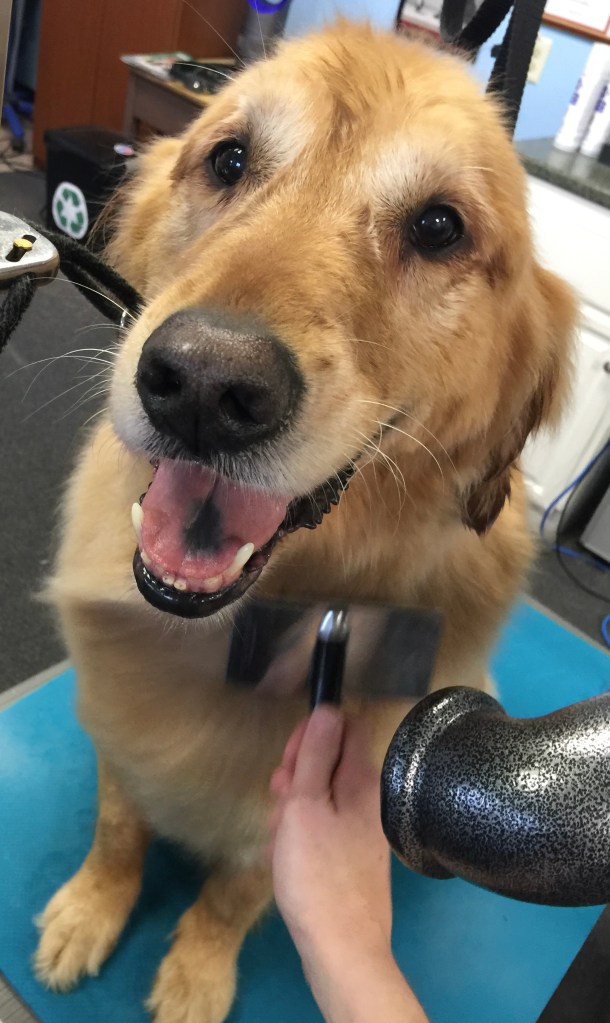
One disadvantage of using an HV dryer is that the dog still needs to be brushed afterwards. Many groomers elect to dry a dog completely with the HV and then brush the coat. This is where the stand dryer shines. I will dry a dog 99.9% with the HV, then move them to the grooming table for brushing. The gentle air from the stand dryer is enough to finish the coat. Not only that, but the ideal time to brush is during the fluff dry! Upon placing the airflow on the coat, it separates the hairs into sections. It now becomes easy to see which hairs need extra attention, if there is extra shedding coat, where mats may be present, and also to check once again for any signs of distress on the skin – you can never check too many times!
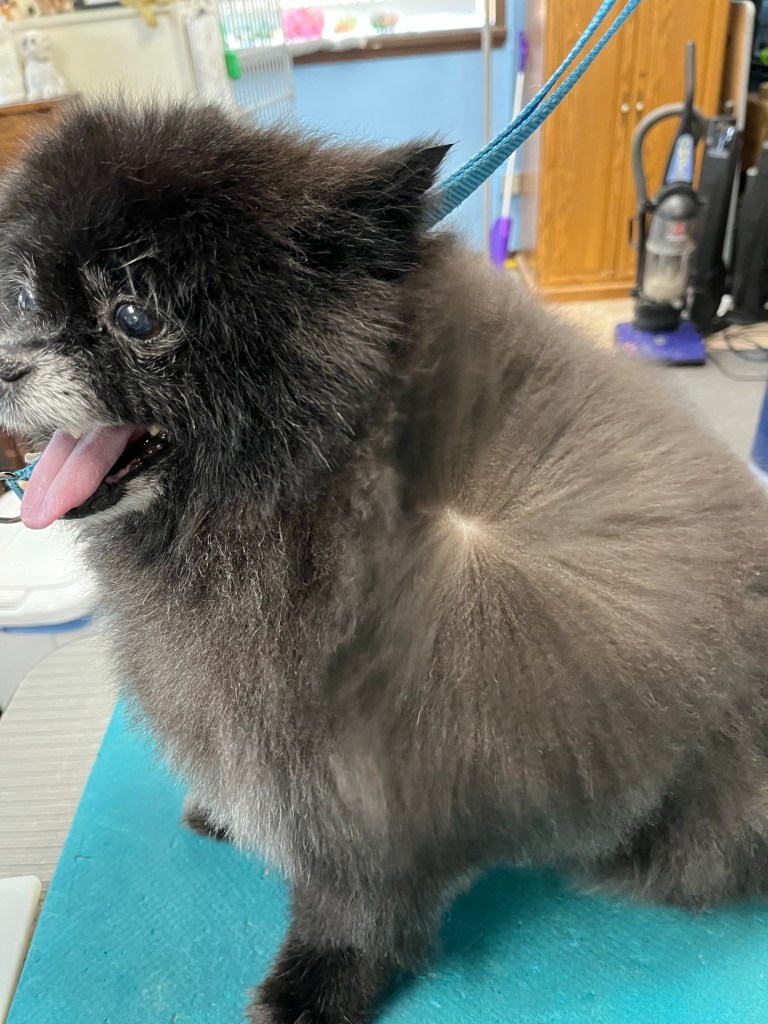
Another disadvantage of HV dryers is that they are loud. Very loud. And some dogs are terrified beyond all reason of that sound. Perhaps it is also the sensation that it makes on the skin. After all, you are basically creating a miniature hurricane and pointing it at the dog! Puppies, nervous dogs, and senior dogs are the most susceptible to these terrifying factors, and are in the most danger. Luckily, most HV dryers (both of mine!) are adjustable speed, which can tame the storm to a moderate gale. When the dog is still unable to handle the HV beastie, a stand dryer can be a boon. The noise level is much lower, and the airflow is gentle and wider. Plus, most stand dryers contain a heating element which (with proper monitoring) can make for a more comfortable temperature – something a wet dog loves!
“But I’m going to brush the dog anyway.”
Well, why not up the ante a little? The stand dryer’s gentle air separates the hair over a large area, just enough for the stylist to see any problems, but also to work with the coat as well!
“I’m going to brush while I HV dry then.”
Bad idea. The HV dryer was designed to quickly dry a small area with a large amount of forced air. Brush with an HV dryer cranked up to 11, and you run the risk of having the brush being blown up against the skin – ouch! Even when turned down to the lowest setting, an HV dryer still has more force than a stand dryer will. If there is long coat being blown around, it is likely to be blown into the brush, leading to tangles from a groomer’s nightmares. Also consider that you will be working with a smaller area than if you were using a stand dryer. It would be like using a weed whacker to mow your entire lawn… or like using a tiny pair of 6-inch scissors to completely finish a massive Newfie. Yikes!
“There’s not enough room! And they’re so clunky!”

This one is a big obstacle for many stylists, as shops can only work with the amount of square footage of our salons; mobile groomers (both vehicle-based and house call) are at an even bigger disadvantage. Stand dryers require a little extra room for their base, as they are essentially a drying machine on a stick. Luckily, as with most grooming equipment today, there are more options available! Stand dryers are being manufactured smaller, and some are able to rest easily on the grooming table.
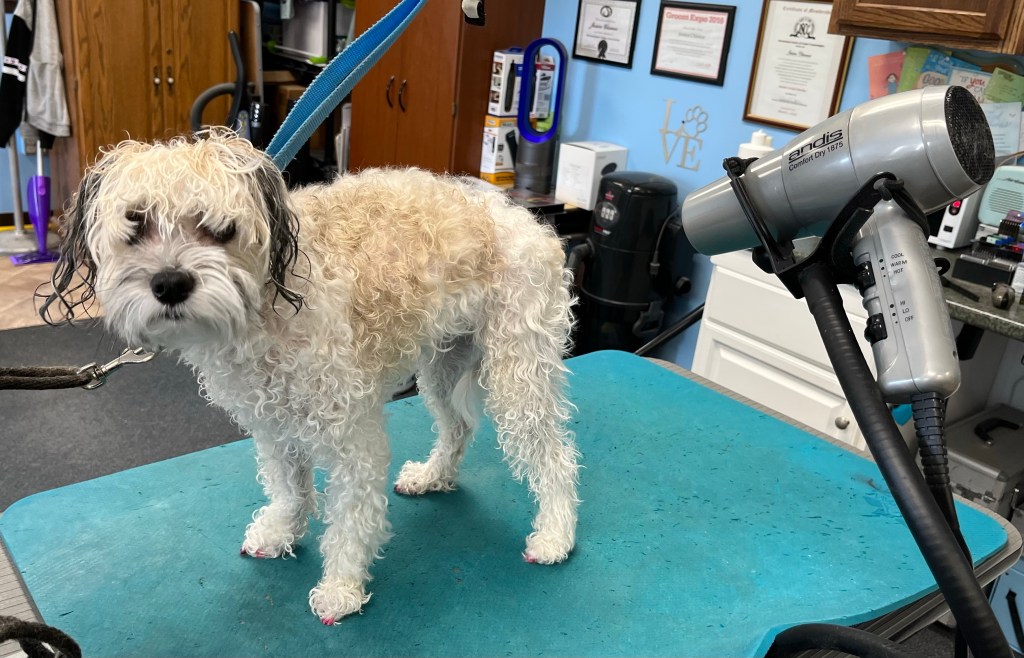
Another popular option is for stylists to purchase a table clamp (affectionately referred to as a “third arm”) that supports a small handheld dryer. The effect is very similar to that of a full-sized stand dryer, and is also a more affordable option. I keep one on hand myself for my very Nervous Nellies!

“But who has the time?”
When used properly, a stand dryer will not add extra time onto your groom. In fact, when used in conjunction with a force dryer, the stand dryer may save you many minutes in the long run! Because the dog is guaranteed to be brushed all the way down to the skin, the skin will be even more monitored, the coat will be ideally set, undercoat and matting will be dealt with swiftly – sounds like a good plan to me!
“Should I stand dry only certain dogs?”
I stand dry every single dog. Yes, even the short coats. In fact, I’ve found the stand dryer to be the perfect finisher for them. I tend to avoid HV drying short coats, as it puts undue stress on each hair. Similarly, for smooth coats, I only HV enough to loosen any shedding undercoat. I wrap them up tight and let them dry in the ambient air. I also never use kennel dryers on any dog – I feel even with monitoring, they are simply too dangerous. A few thick towels and a kennel made from high-impact laminate is surprisingly warm and snuggly – many of my dogs fall asleep! Any trace of moisture left at the end of the session is removed by using the stand dryer and the proper brushing tool (hound glove for short coats and soft slicker for smooth coats). Dogs lean into the airflow, seeming to wish it could last forever. This is also an excellent method for puppies, nervous dogs, and seniors who can’t tolerate HV drying. Indeed, stand drying is beneficial for at least 18 coat types (I don’t have any hairless or corded clients).
I would love to teach a class on stand dryers and their many uses. Where many groomers wrote them off as “outdated”, they are a “tried and true” piece of equipment. While they are no longer the “it” method, their important roles in the art of styling dogs must not go underestimated!
 Bath to Bows LLC